Thursday, April 14, 2016


Concentrate on Chemistry!
With lab partner Fabiana B.


Purpose: To learn from solutions and look closer at dissolved substances in solutions.


Hypothesis: Predictions: 9 tablespoons of sugar and 9 tablespoons of salt.


Materials:
  • Sugar, C12H22O11 (60 g)
  • Salt, NaCl       (60 g)
  • Water, H2O (200 mL)
  • 250 mL beakers (2)
  • Balance
  • Stirring Rod
  • 2 spatulas or plastic spoons
  • 2 green or red gummy bears.


Safety:
Sugar can be slightly hazardous after prolonged exposure to skin, eyes, and if inhaled.
(Material Safety Data Sheet, Sugar)


Salt can be irritant to skin, eyes, and if inhaled.  
(Material Safety Data Sheet, NaCl)


Procedure:
  1. Firstly, make a prediction about how much (in grams) sugar can be dissolved in 100 mL of water. Do the same for the salt.
  2. Find the combined mass of a beaker with 100 mL of water in it.
  3. Then, add sugar to the water until the water will no longer dissolve any more sugar. Enter data into the table about how much sugar it took to saturate the water.
  4. Repeat the steps using fresh water and table salt.


Part II
  1. Put a gummy bear into the sugar solution overnight and record observations.


Background:
This lab studies the point at which water is saturated with sugar/ salt. Saturation occurs when the solute (in this lab, water) can dissolve no more solvent (in this case, sugar or salt). Concentration is how much solute there is per a solution.

Data:
_________________________________________________________________________________
Solid Solute Volume of Mass of Mass of Volume of
water (mL) water and solution and solution (mL)
beaker (g) beaker (g)
_________________________________________________________________________________
Sugar 100 113.08 221 165
C12H22O11
_________________________________________________________________________________
Salt  100 113.23 133.1 100
NaCl
_________________________________________________________________________________

Calculations

1)To find mass of solid added:
Mass of solution and beaker - Mass or water and beaker= Mass of solid added
Sugar: 221.0-113.08= 107.92
Salt: 133.1-113.23= 19.87
2) To find mass of solid per liter of solution:
Mass of solid added/ (volume of solution (mL)/ 1000, to convert to liters)
107.92/(165/1000)= 654.06 g/L

3) To find moles of solid added (mol)
(Mass of solid added) (1 mol)/ (mohler mass)= Moles of solid added

107.92/ 342.11= .315 moles

4) To find the Moles of dissolved solid/ liter:

Moles of solid added/ volume of solution (L)

.315/ .165= 1.90 moles/Liter


_________________________________________________________________________________
Mass of                        Mass of                             Moles of                          Moles of
solid added dissolved solid solid added dissolved solid
(g) per liter of solution (mol) per liter of solution
(g/L) (mol/L)
_________________________________________________________________________________
Sugar: 107.92               654.06                              .315                                     1.90
________________________________________________________________________________
Salt:    19.87                 198.7                                .339                                     3.39         
________________________________________________________________________________

Part II:
1) The bears in the solution and their reaction to the solutions in which they are placed in vary.


A) This bear was in water, and expanded greatly and held more water than any other solution. This is because in an unsaturated solution, the water is trying to absorb more and is moving throughout the gummy bear to expand it.
B) This is a mostly water solution, however, with some sugar and this has an impact on the size of the gummy bear, the more saturated the sugar solution becomes, the less the water will expand the gummy bear because there is less water to run through the gummy bear. 

C) This is a further degree of letter B in that there is more sugar in the C solution than there is in either A or B and this prevents the gummy bear's expansion. This gummy bear is smaller than either A or B because of the higher concentration of sugar. 

D) This is a more though not completely saturated solution. The gummy bear is even more compressed than either A, B, or C and this is due to the high sugar content of the water. 

E) This gummy bear has hardly expanded at all and this is to due, as already outlined, to saturation. The solution in which the gummy bear is in is a corn syrup solution. It cannot hold any more sugar. and there isn't enough water to move through the gummy bear and expand it.

2) If it was sugar moving into and through the bears, the sugar solution would be the most inflated and the water solution would have the most compressed gummy bears. 

3) The gummy bear left overnight shrunk, like letter E solution. This shows that the solution is saturated because the gummy bear was not only heavier than the solution and sunk, it also didn't expand in size. 


Discussion of Error: In this lab, there was an error in which part of the salt solution was spilled before the volume could be measured for the second time. Thus, the reason for only 100 mL being recorded for the volume of the salt solution.


Conclusion: The original hypothesis was wrong because the water was able to hold 20 teaspoons of sugar and the salt water saturated at 12 teaspoons. The purpose was carried out in that saturation and the process of saturating was witnessed.

Questions:
1) Because the NaCl Molecule is a lot smaller than a sugar molecule, a lot more mols of NaCl were able to fit into one liter. With the dissolved solid/ liter, the number is much greater because the sugar solution was able to hold and dissolve more than the salt solution could dissolve of salt.

2) The volume is different because in the lab, matter was added to the water, it is no longer just a water solution but a water and sugar/ salt solution. This extra sugar/ salt takes up more space than the water did alone.

3) 12 percent of 2.3 (g) =.27 
.27/ .001= 270
(.27)/ (342.119)
.000789/ .001
The gummy bears contain a concentration of .789 mols of sugar per liter.


Citations:
Material Safety Data Sheet. Sucrose. thesciencelab.com. Retrieved from:
http://www.sciencelab.com/msds.php?msdsId=9927285.

Material Safety Data Sheet. Table Salt, NaCl. thesciencelab.com. Retrieved from: http://www.sciencelab.com/msds.php?msdsId=9927593




Tuesday, March 8, 2016

Carolina Wasinger
Ms. Bowser
Chemistry
3/6/2016

Can I have change for that?

Purpose: To look and study examples of physical and chemical changes and how these changes relate to the mass of the reactants and products. 

Hypothesis: 

  1. Equation: NaCl (s) ->NaCl (aq)  
                         Hypothesis: The mass  will be the same before and after combining (because of conservation of mass) the H2O and NaCl (s) to form NaCl (aq)  

    
     2. Equation: Na2CO3 (aq) + CaCl2 (aq)  ->  2NaCl(aq) + CaCO3 (s)
                          Hypothesis: The mass of the products and reactants in this experiment will be the same (due to the law of conservation of mass)


   3. Equation:  Na2CO3 (aq) + 2C2H4O (aq) -> 2NaC2H3O2 (aq) +  H2O (l) +  CO2 (g)
                         Hypothesis: The mass in this experiment will decrease after the reactants are combined; because a gas will form (CO2 (g)) which will escape the beaker therefore decreasing the total mass of the combined products. 

Procedure: 

For each of the three equations, weigh the mass of the reactants before and after combining. Measure reactants as instructed for each of the equations. Be sure to measure both masses with both containers on the scale. 

                                                                                         (Martyn F. Chillmaid)


Equation 1:  1 gram of  NaCl (s) and 20 mL of water (H2O) in separate containers. 
Equation 2:  20 mL of  Na2CO3 (aq) and 20 mL CaCl2 (aq)  in separate containers.  
Equation 3:  20 mL of  Na2CO3 (aq) and 20 mL of  C2H4O2 (aq) in separate containers. 


Safety: 
NaCl irratent to eye, skin and if ingested or inhaled (Material Safety Data Sheet: Sodium Chloride MSDS)

H2O, Non-corrosive, non-irratant, non permeator for skin. (Material Safety Data Sheet. Water MSDS.)

Na2CO3 (aq), irratint to eyes and skin. Can cause lung irritation and blindness. severity of skin corrosion depends upon length of time substance on skin. ( Material Safety Data Sheet: Sodium carbonate monohydrate MSDS) 

 CaCl2 (aq), irratant to skin, eyes, and if ingested or inhaled. Can permeate skin and harmful ( Material Safety Data Sheet: Calcium chloride anhydrous MSDS). 

 C2H4O2 (aq), irratint to skin, eyes and if ingested or inhaled. Permeates skin (Material Safety Data Sheet: Methyl Formate MSDS)

Materials: 

  • Balance
  • Transparent plastic cups
  • water
  • NaCl (s), 1 g
  • 1.0 M Na2CO3 (aq) 40 mL
  • 1.0 M CaCl2 (aq)
  • Acetic Acid, C2H4O2, 20 mL
  • Graduated Cylinder
Background
The Law of Conservation of Mass states that matter can be changed from one form to another without the mass of the matter fluctuating. At the micro level, this means that no single atoms are gained or lost (excluding error) during the experiment. For the macro level, we can weigh the amount of mass in matter before and after the experiment to prove this law (The Law of Conservation of Mass.)

Data:
Reaction #1

Reactants/Products:   Chemical Name                Description                  Mass before      Mass after
____________________________________________________________________________
NaCl(S)                  Sodium Chloride                             Light colored powder      23.45
H2O                        Water                                               Clear liquid             
____________________________________________________________________________           
NaCl (aq)              Sodium Chloride (aq)                     Cloudy in the water                                  23.425
____________________________________________________________________________

Reaction #2
Reactants/Products:   Chemical Name                Description                         Mass before      Mass after
_________________________________________________________________________________
Na2CO3(aq)            Sodium Carbonate (aq)            Watery substance          45.70 
CaCl2 (aq)               Calcium Chloride                      Watery and pale _________________________________________________________________________________
CaCO3 (s)              Calcium Carbonate                     Powder in cloudy water                       45.673
NaCl (aq)               Sodium Carbonate                      Watery 


Reaction #3 
Reactants/Products:   Chemical Name                Description                         Mass before      Mass after
_________________________________________________________________________________
Na2CO3 (aq)          Sodium Carbonate               Thin/ watery                       41.7
C2H4O2 (ag)         Vinegar                                 Clear, liquid 
_________________________________________________________________________________

NaC2H3O2 (aq)     Sodium Carbonate                Clear liquid                                                   40.1
CO2 (g)                   Carbon dioxide                    Clear gas                              
_________________________________________________________________________________  


Calculations:
In reaction #3)    41.7- 40.1= 1.6
1.6 mL of gas escaped during the 3rd experiment. 

Percent Error
Reaction # 1      =  .09 %
Reaction #2       =  .044%
Reaction #3       =   3.84%

Discussion of Error
The error in this lab was due to the swishing method in which the products were combined using a method of swishing the tubes to insure proper combination of the compounds. This method perhaps led to stray drops falling from the test tube; thus, a decrease in the compounds overall mass. In experiment #3, the reason for such a large percent error was really not an error; rather, the gas that was formed in the container during the reaction escaped the container thus decreasing the overall final mass. 

Questions:
5) SO3 (g) + H2O (l) -> H2SO4 (aq)
H2SO4 could be ingested or absorbed through the skin. 

6) 2Li + 2HCl -> H2 + 2LiCL (aq) + H2 (g)
2LiCl could be absorbed through the skin or be ingested. H2 could be inhaled. 

7) AgNO3 (aq) + NaOH (aq) -> NaNO3 (aq) + AgOH (aq) 
Could be ingested or absorbed through the skin. 


Conclusion:
The hypothesis of this lab was correct in all the predictions of the masses of the three reactions before and after the experiment. The purpose of this lab was fulfilled in that the class studied physical and chemical changes and related these changes to mass.


Citations:
Martyn F. Chillmaid. Science Photo Library. http://www.sciencephoto.com/media/4621/view

Sciencelab.com. Chemicals and laboratory equipment. (5/21/2013). Material Safety Data Sheet: Sodium Chloride MSDS. Retrieved from:  http://www.sciencelab.com/msds.php?msdsId=9927593


Sciencelab.com. Chemicals and laboratory equipment. (5/21/2013). Material Safety Data Sheet: Water MSDS. Retrieved from http://www.sciencelab.com/msds.php?msdsId=9927321

Sciencelab.com. Chemicals and laboratory equipment. (5/21/2013). Material Safety Data Sheet: Sodium carbonate monohydrate MSDS. Retrieved from: http://www.sciencelab.com/msds.php?msdsId=9927591

Sciencelab.com. Chemicals and laboratory equipment. (5/21/2013). Material Safety Data Sheet: Calcium chloride anhydrous MSDS. http://www.sciencelab.com/msds.php?msdsId=9923251

Sciencelab.com. Chemicals and laboratory equipment. (5/21/2013). Material Safety Data Sheet: Methyl Formate MSDS.  http://www.sciencelab.com/msds.php?msdsId=9926061

The Law of Conservation of Mass. http://www.chem.wisc.edu/deptfiles/genchem/sstutorial/Text1/Tx14/tx14.html


Monday, January 25, 2016

Carolina Wasinger
Ms. Bowser
Chemistry
January 24, 2016

I am in high school, I don't have any degrees

Purpose: To use a thermometer, learn how it works, and observe how changes in temperature effect the thermometer. 


Materials: 

Part I: 
  • Small glass vial
  • (3) 250 mL beakers
  • Hot plate
  • Ice 
  • Ice water
  • Salt
  • Small metric ruler
  • Ethylene glycol (antifreeze) (25 mL in each thermometer
  • Rubber Septum or rubber stopper
  • Plastic straw
  • test tube holder, wire
  • Permanent marker
Part II:
  • 250 mL beakers (3)
  • Ice
  • Test tube holder, wire
  • Hot plate
  • 10 mL graduated cylinder

Safety: 

Hot Plate: Be sure when using the hot plate (to boil water) to not directly touch the heated surface of the hot plate as burns may result. 

Ethylene Glycol (Antifreeze)( HOCH2CH2OH): Being exposed to this substance for large amounts of time can result in death. Can be harmful/ irritating to skin and eyes and permeate. Hazardous for inhalation (Material Safety Data Sheet). 

Background: 

The Thermometer is used to measure temperature and there two commonly used units of measurement: Celsius and Fahrenheit. Celsius units were invited by  Anders Celsius, an astronomer (The Physics Classroom). On the Celsius scale, Water boils at 100 degrees and freezes at 0 degrees. Physicist Daniel Fahrenheit invented the other commonly used unit of measurement for temperature, degrees Fahrenheit (The Physics Classroom). In degrees Fahrenheit, water freezes at 32 degrees and boils at 212 degrees.
For creating a scale for a thermometer, pick a number for a certain temperature (i.e. 6 degrees for water freezing and 103 degrees for water boiling).
Typically, a thermometer consists of a liquid inside of a clear tube. As temperatures rise, so does the liquid inside the thermometer and when the temperature falls, the height of the liquid inside the tube falls as well (Mary Bellis). This occurs because when higher temperatures occur, the molecules become farther apart and the only way to create more room for the molecules to move about is by increasing volume and to do that, the liquid must expand upwards (How Things Work). When the temperature falls, the molecules come closer together (How Things Work). 

Questions from 3.4

  1. The rising and falling of the Ethylene glycol in the tube. 
  2. The temperature change. The density is changing and the volume . The higher temperatures forces the liquid in the tube to expand and travel upwards in the tube.
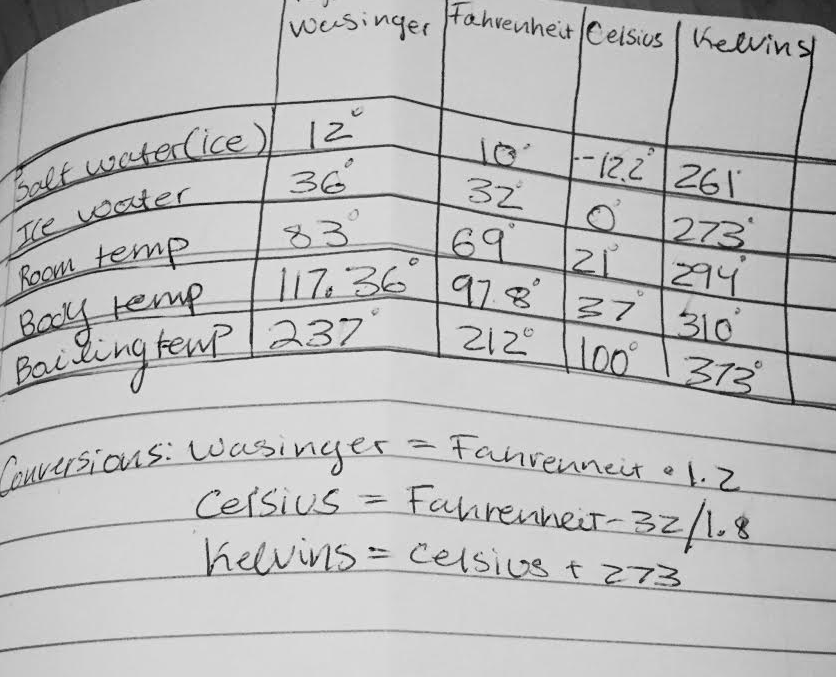
     3.   A)For boiling water, 212 degrees Fahrenheit is equal to 237.44 degrees Wasinger. For ice water, 32 degrees Fahrenheit is equal to 35.84 Wasinger. I chose these numbers because I wanted an even more exact measurement of temperature than Fahrenheit, so even smaller degrees.
           B) The room temperature is 82.8 degrees Wasinger or 69 degrees Fahrenheit. To convert Fahrenheit to Wasinger: Multiply the degrees in Fahrenheit by 1.2.


Procedure:

Part I:


  • Put the thermometer in the varying heat conditions (there are five total heat tests for the thermometer) and record where the thermometers' liquid stops climbing by marking it with a permanent marker. 
  • Measure the temperature with the thermometer at room temperature, when it is placed in a hand (body temperature), when it is placed in boiling water, when it is placed in ice water, and when it is placed in a mixture of ice water and salt. 


Part II:

  • Fill a 250 mL beaker with 200 mL of water. The water should be heated to 80 Degrees Celsius. In another 250 mL beaker, put in room temperature water. Put ice into the last beaker. 
  • Use the test tube clamp to place the 10 mL graduated cylinder into the hot water beaker with the opening of the test tube almost touching the bottom of the beaker. Record what you observe. 
  • Remove the 10 mL graduated cylinder from the hot water and place it into the room temperature water following the same method as used with the hot water. Record observations.
  • Add the ice from the third beaker into the room temperature water using the same method used for the previous two beakers. Write down any observations.
Analysis:


  • Changes were observed during the lab due entirely to the change in temperature at each of the individual stations in part I. In part II, the changes were due to the varying temperatures of the water tested. 
Discussion of error, In this lab, there was no error between the conversions from Degrees Wasinger to Fahreinheit, Celsius and Kelvins. 

Conclusion: 
In conclusion, the results for this lab are as follows:

Part I:

Condition                                                            Centimeters                               Degrees Wasinger


Salt Ice Water(general chemistry online)            7.5                                              12                
Ice Water                                                              9                                                 36
Room Temp                                                         11.9                                            83
Body Temp                                                          14                                               117.3
Boiling Temp                                                       32                                               237


Part II:

Hot Beaker: Condensation, steam bubbles

Room Temperature beaker:  Nothing occurred

Iced beaker: Bubble inside graduated cylinder

  • The temperature for the conditions tested were as to be expected. However, part II of the lab had differently anticipated results. A huge bubble formed inside the graduated cylinder in the last test with the ice water. 


Questions: 


Citations: 

General Chemistry Online. Why isn't the lowest possible temperature for salt/ice/water mixture 0?. (n.d). Retrieved from: http://antoine.frostburg.edu/chem/senese/101/solutions/faq/zero-fahrenheit.shtml

How Things Work. How does the thermometer work. (n.d.). Retrieved from:http://www.energyquest.ca.gov/how_it_works/thermometer.html

Mary Bellis. The history of the thermometer. Retrieved from: http://dwb4.unl.edu/chem/chem869m/chem869mlinks/inventors.about.com/science/inventors/library/inventors/blthermometer.htm

Material Safety Data Sheet. Ethylene glycol MSDS. In: Sciencelabchemicals.com. Chemicals and laboratory equipment. Retrieved from: http://www.sciencelab.com/msds.php?msdsId=9927167

Purdue Owl. Joshua M. Paiz, Elizabeth Angeli, Jodi Wagner, Elena Lawrick, Kristen Moore, Michael Anderson, Lars Soderlund, Allen Brizee, Russell Keck.  2015-03-27 01:19:35. Retrieved from: https://owl.english.purdue.edu/owl/resource/560/10/

The Physics Classroom. Temperatures and Thermometers. (n.d.) Retrieved from:http://www.physicsclassroom.com/class/thermalP/Lesson-1/Temperature-and-Thermometers


Wednesday, December 9, 2015

Carolina Wasinger
Chemistry I
12-9-2015
Ms. Bowser
With Partner: Sophie Horn


Purpose:
To discover which liquids are attracted to a negatively charged wand; from this, determine which molecules are polar and nonpolar. Also to observe the property of cohesion in each of the liquids through an experiment involving placing droplets of the substances on waxed paper.

Materials:

  • Glass wand
  • Cheese cloth
  • Beaker
  • Syringe (to create the stream)
  • Water
  • Isopropanol
  • Hexane
  • Acetic Acid
  • Waxed paper. 
  • Pipette. 


Procedure:


  • For each liquid, pour the respective liquid in a steady stream and hold a charged wand (charge by rubbing a glass wand with a cloth.) next to the running stream, 
  • Observe whether or not the stream bends/ is attracted towards the wand. 
  • Next, use a pipette to drop droplets of the liquids onto a piece of waxed paper and observe the shape the liquid takes (or does not).


Background:

A polar molecule is a molecule whose atoms contain different electronegativity values and therefore attract additional electrons (Stacy). Nonpolar molecules contain atoms of equal or very similar electronegativity values (Stacy). Polar molecules tend to mix easily with water and have cohesive properties (Bowser). Cohesive properties means the molecules stick together in order to create surface tension; which is what creates perfectly round drops for molecules like water and acetic acid.

Data:


Compound
Effects of Charged Wand
Behavior on Waxed Paper
Water
Attracts
Round drop
Acetic Acid
Attracts
Round drop
Isopropanol
Attracts
Spreads thinly
Hexane
Does not Attract
Spreads thinly


Analysis:

Water Molecule:


Acetic Acid


Isopropanol Molecule.


Hexane Molecule:


Conclusion:

This lab demonstrated the properties of polar and nonpolar molecules as evidenced in the liquids reaction to the charged wand and wax paper.
Water, Acetic Acid and Isopropanol were all polar.
The only nonpolar molecule was Hexane.

Discussion of error:

In this lab error occurred for mainly the reason that there was not a sure way of determining if the wand was properly charged.


Citations:
Water molecule, http://blog.science-matters.org/2012/04/10/drawing-lewis-structures/

Acetic Acid molecule, http://chemistry.about.com/od/factsstructures/ig/Chemical-Structures---E/Ethanoic-Acid---Acetic-Acid.htm

Isopropanol Moecule, ww.123rf.com/photo_30181595_stock-vector-structural-chemical-formula-of-isopropanol-molecule-2d-and-3d-illustration-isolated-on-white-backgro.html.


Hexane Molecule, 
http://www.edinformatics.com/interactive_molecules/3D/cyclohexane_molecule.htm.

Attractive Molecules. Attractions between molecules. Lesson 15 lab packet. Handed out by: Lindsey Bowser. December 10 2015. Chemistry 1. Period A Foxcroft School, Middleburg VA.

Bowser. (2015). Attractive Molecules: Attractions between molecules.  [Lab worksheet]. Chemistry. Foxcroft School. Middleburg, VA.

Stacy. Angelica. M. (2011). Chapter 2, section 15. Ladie Malek, Jeffrey Dowling. Living by Chemistry (168-171). Emeryville, CA. Key Curriculum Press.


Wednesday, December 2, 2015

Ester Synthesis Lab

Carolina Wasinger
Chemistry
Ms. Bowser.
12/2/2015
Partner: Sophie Horn


Purpose:

To create different smells within a lab experiment transforming different smells into Esters and sweet smelling compounds. 


Procedure :
  1. Fill 50 mL beaker with 30 mL of water 
  2. Drop into the beaker, a boiling stone 
  3. Put the beaker on a hot plate and bring water to a boil
  4. Label test tubes with the following numbers: 1, 2 and 3
  5. Using the wafting technique, smell the acids and record in a data table. Add 5 drops of the respective carboxylic acids to each of the test tubes 
  6. Again, using the wafting technique, smell the alcohols and record in the data table (Bowser lesson 7). Add ten drops of each alcohol to to each tube (look in the following table)


Test tube:             Carboxylic Acid                Alcohol
1                             acetic acid                       isopentanol
2                             acetic acid                       butanol
3                             butyric acid                     ethanol

  1. Add 1 drop of the sulfiric acid (H2SO4) to each test tube
  2. Place a boiling stone into each test tube
  3. Carefully smell each compound by using the wafting technique
  4. Slice a plastic pipette to a length that is shorter than that of the test tube. Put the pipette into the test tube so that the bulb somewhat seals off the test tube
  5. Put the test tubes into boiling water n heat for 5 minutes, or until the compund no longer smells putrid
  6. After, remove the test  tubes from the water and turn off the hot plate
  7. Take the pipette out from the test tube. There should only be vapors in it
  8. squeeze the pipette and waft the vapors, Record the smell on the data sheet
  9. Dispose properly of chemicals (Bowser, Lesson 7)
Materials:

  • 50 mL beaker
  • Hot plate
  • 3 microscale test tubes
  • Boiling stones
  • 3 plastic pipettes
  • scissors 
  • pencil 
  • organic acids and alcohols
    • Acetic Acid C2H4O2
    • Butyric Acid  C4H8O2
    • Concentrated Sulfiic Acid  H2O4S
    • Ethanol C2H6O
    • Isopentanol  C5H12O
    • Butanol C4H10O
(Bowser, lesson 7)

Safety:

Hot Plate; Hot plate can burn. Do not  directly touch the heated surface of the hot plate and use tongs to move items on and off the hot plate (Common knowledge). 

Boiling Stones: Hazardous if swallowed or if comes in contact with eyes in powder form. (Material Data Safety Sheet). 

Acetic Acid, can be erosive to the skin. Keep out of eyes and off skin and clothing (CDC). 

Butyric Acid, Is corrosive to skin, combustible and flammable. Keep away from open flames (CDC). 

Sulfuric Acid. Is corrosive to skin and can cause burns to skin (CDC). 

Ethanol: Can be hazardous id swallowed or if comes into contact with eyes and skin (CDC). 


DATA:


Test Tube #
Smell of Carboxylic Acid
Smell of alcohol
Smell of mixture before heating
Smell of mixture after heating
1
Vinegar
Medicinal
Cherry flavored medicinal syrup
Sweet, fruity
2
Vinegar
Sharpie
Chemically
Slightly like gasoline
3
Putrid
Rubbing alcohol
Putrid
Cherry, sweet fruity medicinal.

After 1 minute: the liquid at the bottom of the test tubes turned yellow (because there is a chemical change that is happening). After, the contents turned to a light pink color.

Background: 
The word Synthesis in this experiment means bringing together specific compounds through a controlled experiment (Bowser lesson 7). 

The sweet-smelling molecules known as Esters have a key structure piece in all of them: A Oxygen atom linking to Carbon atoms one of which is double bonded with another Oxygen atom (Stacy). 

Carboxylic Acids are putrid smelling molecules (Stacy). The key piece in a the structure of a carboxylic acid is an Oxygen atom singly bonded with a hydrogen, and on the other side, a carbon atom. The carbon atom is doubly bonded with a separate Oxygen atom (Stacy). 

Alcohols often smell very strongly medicinal (Stacy). A key part of an alcohols structural formula is a hydrogen singly bonded with an Oxygen atom (Stacy). 

A catalysts role in an experiment is to help the reaction to take place or speed it along (Stacy). Catalysts are not consumed into the reaction (Stacy). 

Analysis:

       From the questions of lesson 8 we analysed the chemical reaction that occurred in the lab. None of the mixtures smelt sweet in the beginning of the lab but rather putrid or strongly medicinal, in the end, all of the compounds should have smelled sweet. 
      In the final molecule, the Ester functional group was present in all three of the compounds. To build new molecules, two hydrogen atoms and an oxygen were taken out of the compounds and the remainder of the two compounds were added together, forming the alcohol and acid mixture. 
     We know from the color changing of the liquids that a chemical reaction was taking place in the test tubes. 


Graphs:


Conclusion:
In conclusion, the chemistry students were able to create new smells and transform organic acids and alcohols from putrid or medicinal to sweet. 

Discussion of Error: Errors in this lab could of occurred to errors such as heating liquids too long but also the perceptions of the different smells. 

Questions:
5.)


  • C8H16O2
  • C7H14O
  • C9H18O
  • C6H12O2

6.)

  • Isopentyl Methanate
  • Butyl Caproate
  • Ethyl Salicate. 
Citations:

Acetic Acid. (N.d.). In: Center for Disease Control and Prevention: NIOSH Pocket Guide to Chemical Hazards. Retrieved from: www.cdc.gov.

Bowser. (2015). Create a Smell Ester Synthesis. [Lab worksheet]. Chemistry. Foxcroft School. Middleburg, VA.

Bowser. (2015). Making scents analyzing Ester synthesis.  [Lab worksheet]. Chemistry. Foxcroft School. Middleburg, VA.

Butryc Acid. (N.d.). In: Center for Disease Control and Prevention: NIOSH Pocket Guide to Chemical Hazards. Retrieved from: www.cdc.gov.

Carborundum Boiling Chips. (N.d.). In: GFS Chemicals: Material data safety sheet. Retrieved from: sds.gfschemicals.com/atn/CARBORUNDUM%20BOILING%20CHIPS%2c%2014%20MESH_Default_MSDS%20US.pdf

Ethyl Alcohol. (N.d.). In: Center for Disease Control and Prevention: NIOSH Pocket Guide to Chemical Hazards. Retrieved from: www.cdc.gov.

Stacy. Angelica. M. (2011). Chapter 2, section 6. Ladie Malek, Jeffrey Dowling. Living by Chemistry (168-171). Emeryville, CA. Key Curriculum Press.

Sulfuric Acid. (N.d.). In: Center for Disease Control and Prevention: NIOSH Pocket Guide to Chemical Hazards. Retrieved from: www.cdc.gov.

Caroline Magnani helped me with graphs section.


Tuesday, November 17, 2015

Carolina Wasinger
Chemistry I
Ms. Bowser
11/17/2015

Pre-lab

Purpose:

To create different smells within a lab experiment. 


Procedure:
  1. Fill 50 mL beaker with 30 mL of water. 
  2. Drop into the beaker, a boiling stone. 
  3. Put the beaker on a hot plate and bring water to a boil.
  4. Label test tubes with the following numbers: 1, 2 and 3
  5. Using the wafting technique, smell the acids and record in a data table. Add 5 drops of the respective carboxylic acids to each of the test tubes. 
  6. Again, using the wafting technique, smell the alcohols and record in the data table. Add ten drops of each alcohol to to each tube (look in the following table). 


Test tube:             Carboxylic Acid                Alcohol
1                             acetic acid                       isopentanol
2                             acetic acid                       butanol
3                             butyric acid                     ethanol

  1. Add 1 drop of the sulfiric acid (H2SO4) to each test tube.
  2. Place a boiling stone into each test tube. 
  3. Carefully smell each compound by using the wafting technique. 
  4. Slice a plastic pipette to a length that is shorter than that of the test tube. Put the pipette into the test tube so that the bulb somewhat seals off the test tube. 
  5. Put the test tubes into boiling water n heat for 5 minutes, or until the compund no longer smells putrid. 
  6. After, remove the test  tubes from the water and turn off the hot plate. 
  7. Take the pipette out from the test tube. There should only be vapors in it. 
  8. squeeze the pipette and waft the vapors, Record the smell on the data sheet.
  9. Dispose properly of chemicals. 
Materials:

  • 50 mL beaker
  • Hot plate. 
  • 3 microscale test tubes. 
  • Boiling stones. 
  • 3 plastic pipettes. 
  • scissors 
  • pencil 
  • organic acids and alcohols ( Acetic Acid, Butyric Acid, concentrated Sulfiic acid, Ethanol, Isopentanol, Butanol.)

Safety:

Hot Plate; Hot plate can burn. Do not  directly touch the heated surface of the hot plate and use tongs to move items on and off the hot plate. 

Boiling Stones: Be sure to handle with tongs. Boiling stones can cause burns. 

Acetic Acid, can be erosive to the skin. Keep out of eyes and off skin and clothing. 

Butyric Acid, Is corrosive to skin, combustible and flammable. Keep away from open flames. 

Sulfiric Acid. Is corrosive to skin and can cause burns to skin. 

Ehanol: 


Monday, November 2, 2015

Carolina Wasinger
Ms. Bowser
11/2/2015
The Conductor has lost his train of thought...


Procedure:
  • Test the conductivity of each of the substances when dry. 
  • After that, put each of the substances in water and observe whether or not the substance dissolves. 
  • If the substance dissolved in the water, test whether or not the water is conducting electricity. 
Materials:

-Conductivity tester. 
-Beakers to hold distilled water. 
-Distilled water. 
-Aluminum Foil. 
-Sucrose (sugar). 
-Sodium chloride (salt). 
-Silicon Dioxide (sand). 
-Paraffin (wax). 
-Ethanol. 
-Copper.
-Calcium Chloride. 
-Copper (II) Sulfate. 

Background:
   
             Whether or not an element conducts electricity is largely dependent on the type of bonding the atoms make with each-other. For instance, Network Convalent bonds tend to be extremely strong and very hard to break, The toughness of a diamond comes from this type of bond. 
             An Ionic bond is when the metal valence electrons move to the nonmetal atoms atoms. Molecular Covalent bonds occur when some atoms but not all share valence electrons. Metallic bonds occur when  the valence electrons are free to move throughout the substance


Hypothesis:

Substance:                            Conduct? Yes/No                       Dissolve? Yes/No

-Distilled water.                    No                                                Yes

-Aluminum Foil.                   Yes                                                No

-Sucrose (sugar).                    No                                                Yes

-Sodium chloride (salt).         No                                                Yes

-Silicon Dioxide (sand).        No                                                 No

-Paraffin (wax).                     No                                                 No

-Ethanol.                                No                                                 No

-Copper.                                Yes                                                 No

-Calcium Chloride.               No                                                  Yes

-Copper (II) Sulfate.             Yes                                                No


Actual Data:


Substance:                        Conduct? Yes/No             Dissolve? Yes/No           Conduct when Dissolved

-Distilled water.                    No                                          Yes                               No

-Aluminum Foil.                   Yes                                         No                                N/A

-Sucrose (sugar).                    No                                         Yes                               No

-Sodium chloride (salt).         No                                          Yes                              Yes

-Silicon Dioxide (sand).        No                                           No                               N/A

-Paraffin (wax).                     No                                            No                               N/A

-Ethanol.                                No                                           Yes                              No

-Copper.                                Yes                                           No                              N/A

-Calcium Chloride.               No                                            Yes                             Yes

-Copper (II) Sulfate.             Yes                                           Yes                              Yes


Analysis. 
For the experiment, the class used a conductivity tester to see whether of not a substance could be a conductor. If so, the class tested if the substance could dissolve in water. If the substance could dissolve in water, the class tested the substances' ability to conduct in water. 

5.) The substances that could light up the bulb were metals, copper, aluminium Both these substances were conductors. 

6.) The substances that did not light up the bulbs were not pure metals. 

The types of bonding predicted for each substance:

Ionic - Sodium Chloride, Copper (II) Sulfate, Calcium Chloride. 

Molecular Covalent-Water, Ethanol. 

Metallic-Aluminum and Copper. 

Network Covalent- Sucrose, Paraffin, Silicon Dioxide. 

The only substances that conducted electricity were in either the Ionic group or the Metallic group. The substances had to have contained metals in order to conduct. 

Discussion:
There were a few instances were the results of our group were different from those of other groups. This was largely due to (we suppose) the condition the conductivity testers were in. The Substances chosen to test would have to be carefully picked because if not, us students could possibly get electrocuted.

Conclusion:
For this lab, my hypotheses were mostly right.  I was wrong in some cases though: I did not predict that Ethanol would dissolve. I did not correctly predict that Copper (II) Sulfate would dissolve. The reasons for my incorrect decisions is mostly due to that I did not know what either of the substances were and I could therefore, not make a reasonable prediction. 

Questions:

1.) 
  • Glass Water Bottle- Network Covalent. 
  • Plastic binder-Network Covalent. 
  • Metal Lamp-Metallic. 
  • Thumb-tacks- Mettallic. 
  • Orange Juice-Molecular Covalent. 
  • Water-Molecular Covalent. 
  • Salt- Ionic
  • -Ionic 
2.) 
  1. Copper Jewelry- Metallic. 
  2. Glass Jewelry-Network Covalent. 
  3. Jewelry made from rocks -Molecular Covalent. 
  4. It is impossible to make jewelry from an Ionic compound because it would dissolve in water and be very brittle. 


Works Cited:
You Light Up My Life. Classifying Substances. Lesson 25 lab Packet. Handed out by; Lindsey Bowser. October 26th, 2015  Chemistry I. Period A. Foxcroft School.